

It's 3:14 in the morning on a profoundly wet Tuesday in November, and I'm standing in the exact centre of our Victorian terrace's nursery holding a plastic egg that glows an angry, accusatory red. This egg is supposed to tell me the room temperature, but mostly it just serves to inform me that I'm failing as a father. In the cot to my left, Twin A is radiating heat like a small, damp radiator, her hair plastered to her forehead. In the cot to my right, Twin B feels like she has just been retrieved from a morgue drawer. They're wearing identical cotton sleep suits. They're sleeping in the exact same room. I've precisely zero idea what to do with this information.
This was the exact moment I realized that keeping a tiny human at a survivable temperature is essentially a dark art. You read the parenting books beforehand, and they cheerfully explain that babies can't keep stable their own body heat, but they fail to articulate the sheer, sweat-inducing panic of running your hand down a baby's chest in the pitch black while trying to decipher if they're clammy or just naturally moist.
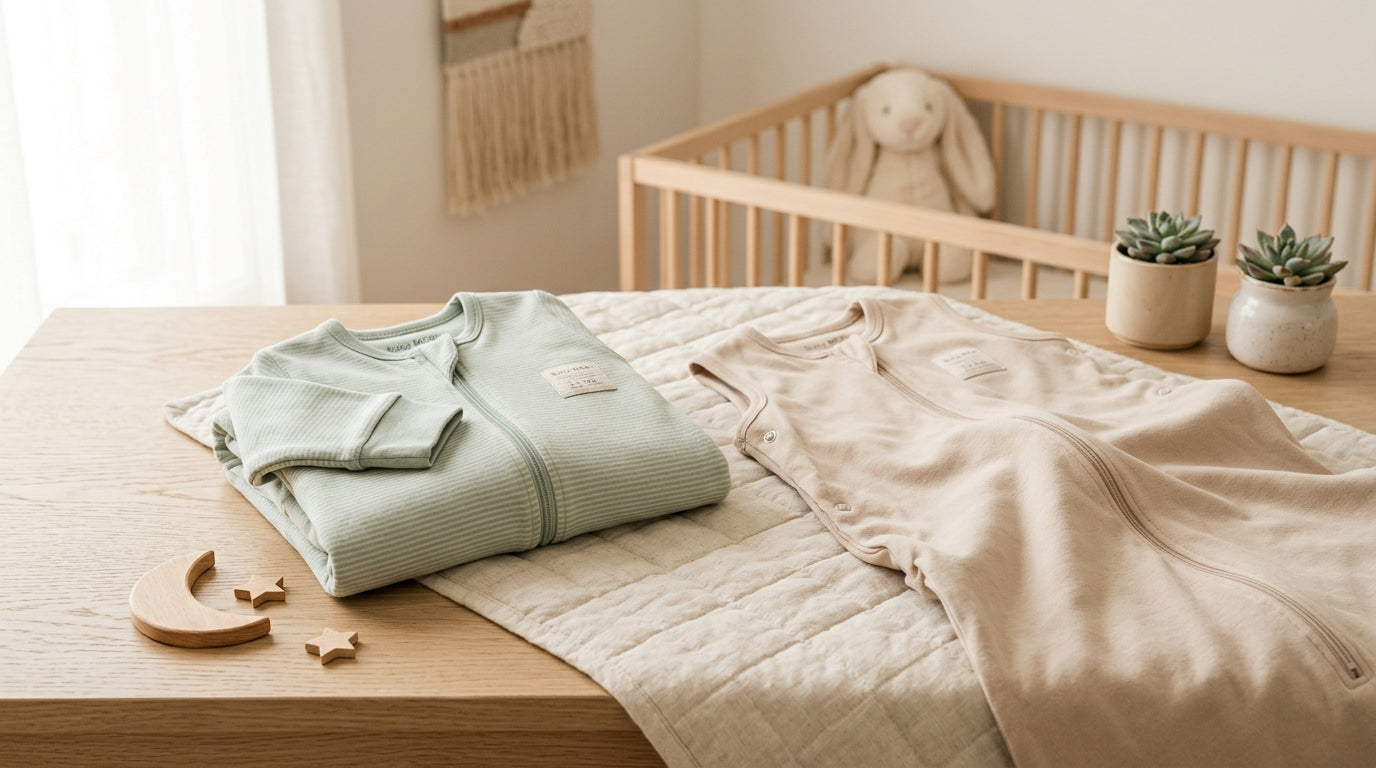
My desperate, late-night phone scrolling led me down a rabbit hole of thermal dynamics, moisture-wicking fabrics, and the cult-like devotion surrounding certain premium sleepwear brands. If you spend more than five minutes on parenting forums at 4 am, you'll inevitably stumble across the whispered reverence for baby MORI sleepwear, a brand that seems to have convinced half of London that their bamboo-cotton blends are spun from actual magic.
The descent into tog rating madness
Before having twins, I thought a tog was something related to sleeping bags you took to muddy music festivals. Suddenly, I was expected to have an encyclopedic knowledge of thermal overall grades. The NHS guidelines vaguely suggest keeping the room between 16 and 20 degrees Celsius, which is brilliant advice unless you live in a drafty London flat where the ambient temperature fluctuates wildly depending on which direction the wind is blowing off the Thames.
Our health visitor, a lovely woman who spoke entirely in rhetorical questions, casually mentioned that overheating is a massive risk factor for infants, which immediately sent my anxiety into the stratosphere. She recommended breathable layers and muttered something about checking their core temperature at the back of the neck, completely ignoring the fact that trying to slip two fingers down the back of a sleeping infant's neck without waking them requires the dexterity of a jewel thief.
In my sleep-deprived state, I panic-bought a small mountain of sleep sacks. I found myself frantically checking labels for the elusive baby m sizing, convinced that if I could just find the perfect 1.5 tog wearable blanket, my daughters would magically sleep through the night. The reality is that dressing a baby for sleep is entirely guesswork shrouded in marketing jargon. You just zip them into a padded bag, stare at the glowing egg thermometer, and pray to whatever deity oversees infant slumber.
Discovering the truth about fabric
The turning point in our nocturnal temperature battles came when I finally understood what the pediatrician was trying to tell me about synthetic fibres. Apparently, wrapping a baby in polyester fleece is roughly equivalent to wrapping them in cling film and leaving them on a radiator. They need fabrics that actually breathe.

This is where the obsessive hype around organic cotton and bamboo actually starts to make a shred of sense. Bamboo is naturally thermo-regulating, which is a very expensive way of saying it stops your child from roasting like a Christmas turkey while still keeping the chill off their toes. I started hunting for natural fibres with the manic intensity of a man looking for water in a desert.
While waiting for our premium sleep sacks to clear the postal backlog, I resorted to traditional layering. It was during this desperate week that I formed a weird, intense emotional attachment to the Organic Cotton Baby Blanket with Squirrel Print. Let me be completely honest here: it's just a blanket. But it's also the specific blanket that saved my sanity.
Twin A developed a violent hatred for being zipped into anything constricting, thrashing around like a tiny, angry salmon. So, under the strict supervision of the baby monitor, I started using this organic cotton blanket for daytime naps. The fabric is stupidly soft—the kind of soft that makes you resent your own scratchy adult bedding. But more importantly, it actually breathed. I could use it to mop up a catastrophic milk spill, throw it over the pram to block out the blinding winter sun, and then wash it at 40 degrees, only to find it came out even softer. It became my emotional support fabric, covered in whimsical woodland creatures that I found myself having whispered conversations with at 2 am.
The daytime awake window delusion
Eventually, you realize that the chaos of the night is entirely dictated by the failures of the day. The internet is absolutely littered with experts telling you to strictly enforce a 45-minute awake window, as if a baby is a parking meter you can just top up with a nap. If you try to force a baby to sleep when they aren't tired while simultaneously trying to stimulate them just enough so they don't get overtired, you'll end up sobbing onto a pile of muslin cloths.
We tried to implement a gentle rhythm of eating, playing, and sleeping. To make easier the playing part, I bought the Panda Play Gym Set. My wife loved it because it has a calming grey palette and natural wood that didn't make our living room look like a plastic factory explosion. It's undeniably beautiful. It looks like it belongs in a Scandinavian design magazine.
Twin B, however, is not a minimalist. She prefers chaos. She would lie under this beautifully crafted, peaceful wooden arch, stare deeply into the crocheted panda's eyes, and then scream until I handed her an empty wipes packet. The play gym was magnificent for Twin A, who would happily bat at the little wooden stars for twenty minutes while I inhaled a cold cup of coffee, but it taught me a valuable lesson: you can buy the most aesthetically pleasing, developmentally appropriate toys on the market, but you can't force your child to appreciate your excellent taste. Still, it made a fantastic prop for the few photos we sent to the grandparents to prove we were raising sophisticated children.
If you're desperately trying to overhaul your nursery to survive the next sleep regression, you might want to browse Kianao's collection of organic baby blankets and minimalist gear before you lose your mind entirely.
The winter regression and the mystery of the baby neck
Right around the six-month mark, just as we had negotiated a fragile truce with their sleep schedule, the weather turned violently cold. The draft in our hallway began to feel like a wind tunnel, and the ambient temperature in the nursery plummeted. The sleep sacks were doing their job for the lower half of their bodies, but their arms and upper chests felt like ice lollies.

This is when I discovered a fundamental anatomical flaw in human infants: they don't have necks. They have a head, and then they've shoulders, and sandwiched between is a series of milk-scented rolls that make layering clothing an absolute nightmare.
I needed something to keep their upper halves warm that wouldn't bunch up and choke them. We started rotating the Baby Sweater Organic Cotton Turtleneck into their daytime and early evening wardrobe. I was highly skeptical of putting a turtleneck on a creature without a neck, but the organic cotton blend really had enough stretch that it didn't bother them. The relaxed fold of the collar provided just enough coverage to stop the London draft from turning them blue, without making them look like tiny, angry Steve Jobs impersonators.
It became our go-to layer for those brutal 5 am wake-ups where the heating hasn't kicked in yet, and you're pacing the floorboards trying to convince a toddler that the sun hasn't risen, so they shouldn't either. The breathable nature of the cotton meant that when the radiators finally did blast to life, I didn't have to frantically strip them down to prevent overheating.
Accepting the nocturnal chaos
We're two years into this experiment now, and the obsession with tog ratings has somewhat faded, replaced by new, equally exhausting anxieties about toddler boundaries and whether or not a discarded piece of toast counts as a vegetable.
Looking back at those endless nights standing in the dark, checking sweaty foreheads and freezing toes, I realize that half the battle wasn't the temperature of the room—it was the temperature of my own anxiety. You buy the expensive bamboo sleep sacks, you invest in the breathable organic cotton blankets, and you memorize the safety guidelines because it gives you a tiny sliver of control in a situation where you essentially have none.
The science of baby sleep is entirely imperfect. Your pediatrician will give you a pamphlet, your health visitor will give you a knowing look, and the internet will give you a complex. But if you wrap them in safe, natural fabrics, check the back of their necks when you're feeling panicked, and try to remember that they're remarkably resilient little creatures, you'll eventually make it to morning. Or at least to 5:30 am, which in the parenting world, is basically the same thing.
Before you completely surrender to the sleep deprivation, upgrade your nursery's thermal defenses with Kianao's organic baby clothing collection.
The messy midnight FAQ
Are those expensive bamboo sleepwear brands really worth the money?
Honestly, it depends on your threshold for middle-of-the-night panic. I found that investing in a few high-quality, breathable items (like baby MORI or equivalent organic cotton blends) stopped me from obsessively checking the thermometer every twenty minutes. The fabric really does wick away moisture, which means less time changing sweaty sheets at 3 am.
How do I genuinely check if my baby is too hot?
Ignore their hands and feet entirely. An infant's extremities are entirely useless for gauging temperature; they almost always feel like little ice blocks because their circulatory system is still figuring things out. Slide two fingers down the back of their neck or onto their chest. If it feels hot and clammy, they're overdressed. If it feels warm and dry, back away slowly and don't make eye contact.
What the hell is a tog rating and do I need to care?
It's a measure of thermal resistance, which sounds incredibly scientific but really just means "how thick the sleeping bag is." A 2.5 tog is for winter (around 16-20°C), a 1.0 tog is for milder weather, and a 0.5 tog is for those brutal heatwaves where everyone is miserable. You should care just enough to not put a 2.5 tog on your kid in August, but don't obsess over it if the room fluctuates a degree or two.
Can I just use regular blankets instead of sleep sacks?
For the first year, medical folks get very twitchy about loose blankets in the cot because of the suffocation risk. Sleep sacks are brilliant because the baby wears the blanket, meaning they can't kick it over their face. I save our beautiful organic cotton blankets for supervised daytime naps, pram walks, and aggressive games of peek-a-boo.
My baby fights the sleep sack, what do I do?
One of my twins hated the restrictive feeling of the bag. We ended up switching to sleep suits with feet (or larger wearable blankets with foot holes) once she was old enough to stand. Until then, we just relied on highly breathable organic cotton footies and cranked the central heating to a consistent, if financially ruinous, baseline.




Share:
The brutal truth about choosing a baby mobile for crib survival
Surviving a Baby MRI: A London Dad's Letter to His Past Self