

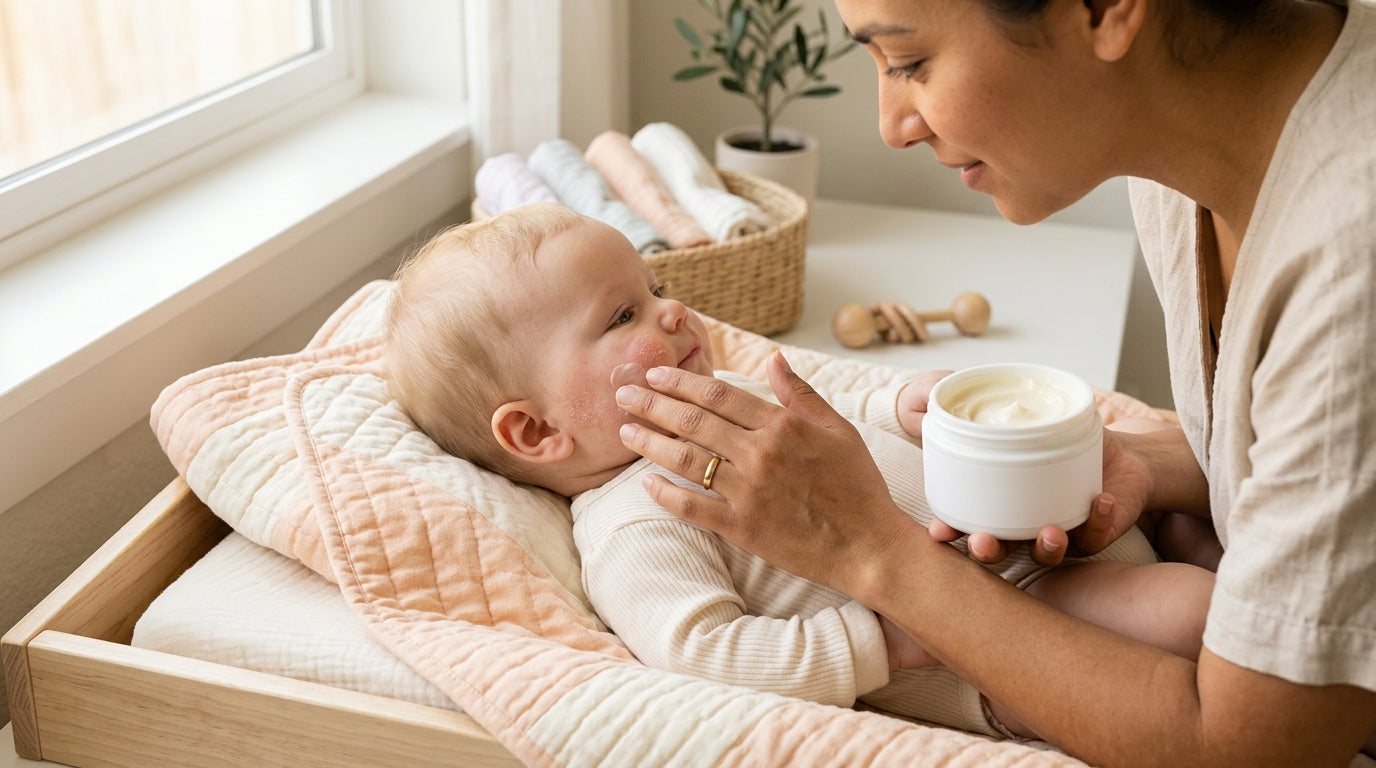
I was sitting in my minivan in the HEB parking lot, crying over a steering wheel covered in crushed Cheerios, because the cashier had just asked me why I let my three-month-old get a severe sunburn in February. I hadn't, obviously, but my oldest son's cheeks were so bright red, crusty, and inflamed that he looked like he had just trekked across the Sahara without sunscreen. I felt like the worst mother in rural Texas, aggressively Googling skin conditions while my iced coffee melted in the cupholder.
That was my brutal introduction to baby eczema. If you're currently staring at your own sweet baby's face, wondering why their normally perfect little cheeks suddenly look like angry sandpaper, I'm just gonna be real with you—it's exhausting, it's expensive, and it'll make you question every single parenting decision you make from the laundry detergent you buy to the clothes you put them in.
My oldest child is basically my walking cautionary tale at this point, because I did absolutely everything wrong before I figured out what was actually happening to his skin. I'm going to tell you exactly how we eventually got his face to clear up, but spoiler alert: it involved a lot of trial, error, and throwing my mother's outdated parenting advice directly out the window.
My grandma and the soap theory
The first thing that happens when your baby develops facial eczema is that older relatives will tell you to wash them more. My grandma, bless her heart, took one look at my son's peeling chin and told me I just needed to scrub his face with a warm washcloth and some good old-fashioned baby soap. So that's what I did, scrubbing away at his delicate little face twice a day thinking I was being a diligent mother, completely unaware that I was basically throwing gasoline on a fire.
I finally broke down and took him to our pediatrician, Dr. Evans, who gently told me to step away from the washcloth. She explained that baby eczema is absolutely not caused by poor hygiene, and scrubbing those crusty patches was actively stripping away whatever microscopic amount of moisture his face had left. She said like a quarter of all babies deal with this to some degree, especially in their first year, but that didn't make me feel any better when I had to look at his miserable, itchy little face every time I nursed him.
Apparently, this whole mess is largely genetic, which my pediatrician tried to explain by comparing his skin to a brick wall that was missing half its mortar. I don't totally understand the cellular biology of it, but from what I gathered, babies with eczema are born lacking this specific protein that normally holds water in and keeps the outside world out, which means their incredibly thin facial skin just leaks moisture into the air constantly while letting in every random irritant they encounter.
The three minute bathroom sprint
Once I knew what we were actually dealing with, Dr. Evans gave me a routine that sounds simple but is actually a highly stressful athletic event. The medical folks call it the soak and seal method, but in our house, it was known as the three-minute panic. I learned very quickly that you can't use hot water or long, lingering baths to soothe an eczema baby, because heat just makes the itching ten times worse.

To keep the skin from drying out completely, you've to basically speed-run a lukewarm five-minute bath and then pull them out, pat them barely dry so they're still damp, and slap a massive, thick layer of grease all over their face and body using gentle downward strokes before three minutes pass and the water evaporates. If you rub the ointment in circles, it creates friction that irritates the hair follicles, and if you wait longer than three minutes, you've missed the window to trap the hydration.
We were going through a tub of premium, fragrance-free healing ointment every single week, which at twenty-six dollars a pop meant my entire Etsy shop profit margin was being funneled directly into my child's cheek grease. I tried those little baby scratch mittens to keep him from tearing his face open at night, but they fall off in exactly four seconds and are completely useless.
When drool becomes battery acid
Right around four months, just as I thought we were getting a handle on the cheek situation, the teething started. Y'all, baby saliva contains digestive enzymes, which means when it pools around the mouth and chin of a baby whose skin barrier is already compromised, it basically acts like battery acid. His chin turned into a raw, weeping mess almost overnight.
You can't stop a baby from drooling, so I started buying silicone toys to keep his gross little hands out of his mouth and hopefully contain the spit. I got him the Panda Teether from Kianao, which is honestly just okay for our specific situation. Don't get me wrong, it's super cute, budget-friendly, and he loved gnawing on the little bamboo stalk, but it doesn't magically stop the drool from cascading down their chin, so you still have to relentlessly reapply a thick barrier balm like plain petroleum jelly around their mouth before every single nap and feeding to block the saliva from burning their skin.
I also realized that his clothes were making the face-rubbing worse. When his face itched, he would thrash his head back and forth against my shoulder, the carpet, the crib mattress, or whatever he happened to be wearing. I eventually bought the Organic Cotton Baby Bodysuit, and while it's a very nice shirt with a great tagless neckline that stopped the rash from spreading to his collarbone, it didn't really solve the problem of him rubbing his cheeks raw when I set him down.
The one fabric that really helped
My absolute holy grail for surviving this phase really ended up being a blanket. When a baby has an itchy face, they'll violently rub their cheeks against the crib sheet like a bear scratching its back on a tree trunk. We had some cheap polyester-blend crib sheets, and every morning he would wake up with his face looking like hamburger meat from the friction.

I finally got desperate and ordered the Plain Bamboo Baby Blanket, and I'm not exaggerating when I say it changed our nights. Bamboo is ridiculously silky and naturally cool to the touch, so when I laid it down flat under him during supervised tummy time or wrapped him in it, he could thrash his little face back and forth without the fabric catching or tearing his fragile skin. It's expensive for a blanket, but it's so soft and breathes so well that it didn't trap the heat that usually triggered his flare-ups. I eventually bought three of them in the sage green color because I absolutely refused to be caught without a clean one on laundry day.
If you're dealing with angry baby skin, you might want to look into swapping out whatever synthetic fabrics are currently touching their face. You can check out more of their breathable stuff in the baby blankets collection to see if it helps.
Steroids and the peanut butter panic
The scariest part of this whole ordeal was the medication and the allergy warnings. When his face got really bad, Dr. Evans told me to use a mild, one-percent over-the-counter hydrocortisone cream to break the soreness cycle. But she looked me dead in the eye and told me to never, ever put strong steroids near his eyelids, because the skin there's so incredibly thin that the medicine can absorb into the eyeball and cause actual eye damage like glaucoma, which is a horrifying sentence that will keep a mother awake for six consecutive years.
Then came the food allergy talk. I had always assumed that if a baby had eczema, it meant they were allergic to whatever I was eating while breastfeeding, so I had preemptively cut out dairy, soy, and gluten, making myself miserable for absolutely no reason. My doctor blew my mind by explaining that food allergies usually don't cause eczema, but having eczema really causes food allergies.
I guess because their broken skin barrier lets microscopic food particles floating in the air seep into their bloodstream before they ever genuinely eat the food, their immune system freaks out and decides that things like peanut dust are a threat. To stop this, I was told I had to feed my four-month-old baby actual peanut butter to train his stomach to tolerate it before his skin learned to hate it, which felt completely unnatural and terrifying, but apparently it's the current medical standard to prevent permanent allergies.
My oldest is four now, and while he still gets dry patches behind his knees when the Texas weather turns cold, his face is totally clear. You will get through this weird, greasy, stressful season. Just trust your gut, ignore the old ladies at the grocery store, and invest in fabrics that don't feel like a cheese grater.
If you're ready to ditch the rough synthetic fabrics that are making your baby's cheeks even angrier, go grab that incredibly soft bamboo blanket right now. Shop the Plain Bamboo Baby Blanket here.
Questions moms seriously ask about baby face eczema
Why is my baby's eczema only on their face?
Because their facial skin is ridiculously thin and exposed to literally everything. Unlike their little legs that are protected by pants, their face is out in the open getting blasted by cold air, rubbed against your sweater, and constantly marinated in their own drool and spit-up. It's just the most vulnerable real estate on their body.
Can I just put breastmilk on their eczema patches?
Look, I tried this because the internet told me breastmilk cures everything from pink eye to taxes. Sometimes it seemed to calm the redness for like an hour, but breastmilk has natural sugars in it, and my doctor warned me that if their skin barrier is really broken and open, slapping sugar-water on it can sometimes invite bacteria to throw a party on their cheeks. If it's a severe flare, stick to the thick, boring ointments.
Should I stop eating dairy if my breastfed baby has face eczema?
I did this, and I missed cheese so much I cried, and it didn't even fix his face. Unless your pediatrician explicitly tells you your baby has a diagnosed dairy protein allergy (usually you'll see nasty, mucousy diapers too), cutting out foods is probably just going to make you hungry and resentful. Fix the skin from the outside first.
How often should I give them a bath?
I used to think bathing them every day was drying them out, but my doctor really told me to bathe him daily during a bad flare-up. The trick isn't skipping the bath; it's making sure the bath is short, barely warm, and followed immediately by that insane three-minute race to cover them in ointment. The bath puts water into the skin, the grease locks it there.
Will they outgrow this or is this forever?
Most kids genuinely do outgrow the worst of it. My oldest had a face like a tomato at four months, but by the time he hit his second birthday, his skin had thickened up and figured itself out. He still gets a little dry in the winter, but that terrifying, angry red facial peeling phase usually peaks in the first year and then gets so much better.




Share:
Spotting Baby Ear Infection Symptoms In The Middle Of The Night
Let's talk about the baby einstein aquarium and infant sleep